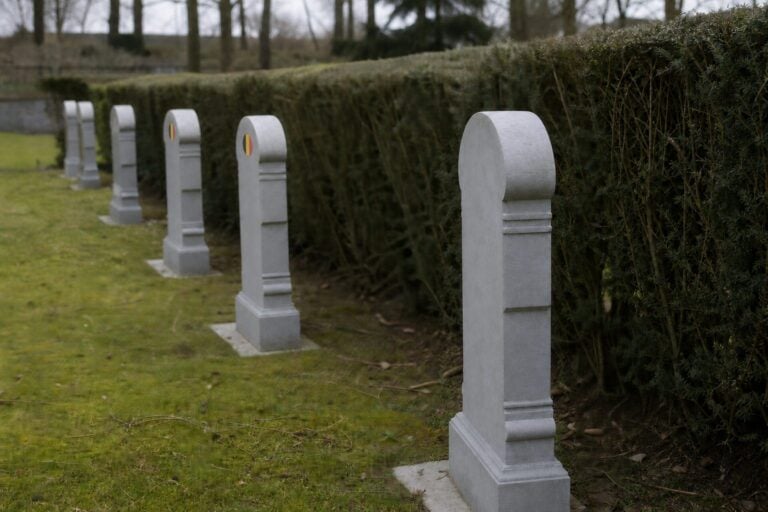
The Belgian military cemetery of Champion is a military cemetery on Rue de Fernelmont in the Belgian village of Champion. This cemetery covers an area of 81 ares and contains 491 Belgian graves and 32 French graves from the First World War. Of the 491 Belgian soldiers, 178 are unidentified. The cemetery also contains one Belgian grave from the Second World War. Most of the soldiers buried here died near Fort de Marchovelette in August 1914. Since 2023, this cemetery has been maintained by the War Heritage Institute (WHI). Before that, the Belgian Ministry of Defence was responsible for the maintenance and management of military cemeteries, including the one in Champion. In 2007, Inducoat Ecological, then still known as HorsemenCare, was allowed to carry out an extensive trial. During the annual evaluation by Mr Guido Pattyn, it continued to prove convincing year after year. This was also recorded on video.
The wax treatment trial
In the evaluation at the time, the environmental aspect of the wax treatment applied was described as important. However, vapour permeability was decisive. The treatment allows the stone to transmit water vapour while protecting it against external moisture ingress. This helps limit damage such as cracking or flaking caused by trapped moisture. The wax forms a water-repellent treatment on the surface of the stone, reducing the opportunity for rain and other forms of precipitation to penetrate the stone. In such a special place, preserving the appearance is also important. The treatment is intended to preserve the stone’s original colour and texture.
Results according to the project evaluation
Pattyn’s evaluation showed that protection against moisture and contamination allowed the stones to last longer without significant degradation. The reduction in biological growth also worked well. The water-repellent properties of the wax can reduce the growth of moss, algae and mould on the surface of the stones. Ultimately, this saved work: less frequent maintenance reduces costs and limits the effort required.
Discussions with the WHI are currently still ongoing to reintroduce them to this technology. Unfortunately, organisational changes meant that the pilot was no longer embedded. For now, however, the stones still look magnificent.
View more Ecological projects or read how a Test & Trust trial area makes a treatment testable in advance.