

Safety of mould-resistant systems
Mould treatment is not only about killing visible mould. From an occupational safety and building physics perspective, it involves three things at once: limiting exposure to spores and chemical agents, preventing unnecessary environmental impact and addressing recurring growth, including when moisture or inadequate ventilation plays a role. A responsible and sustainable system approach is only possible when these factors are assessed together.
This page focuses specifically on the safety of chemical agents and personal protection, to dispel misconceptions and superficial marketing claims using chemical and legal facts.
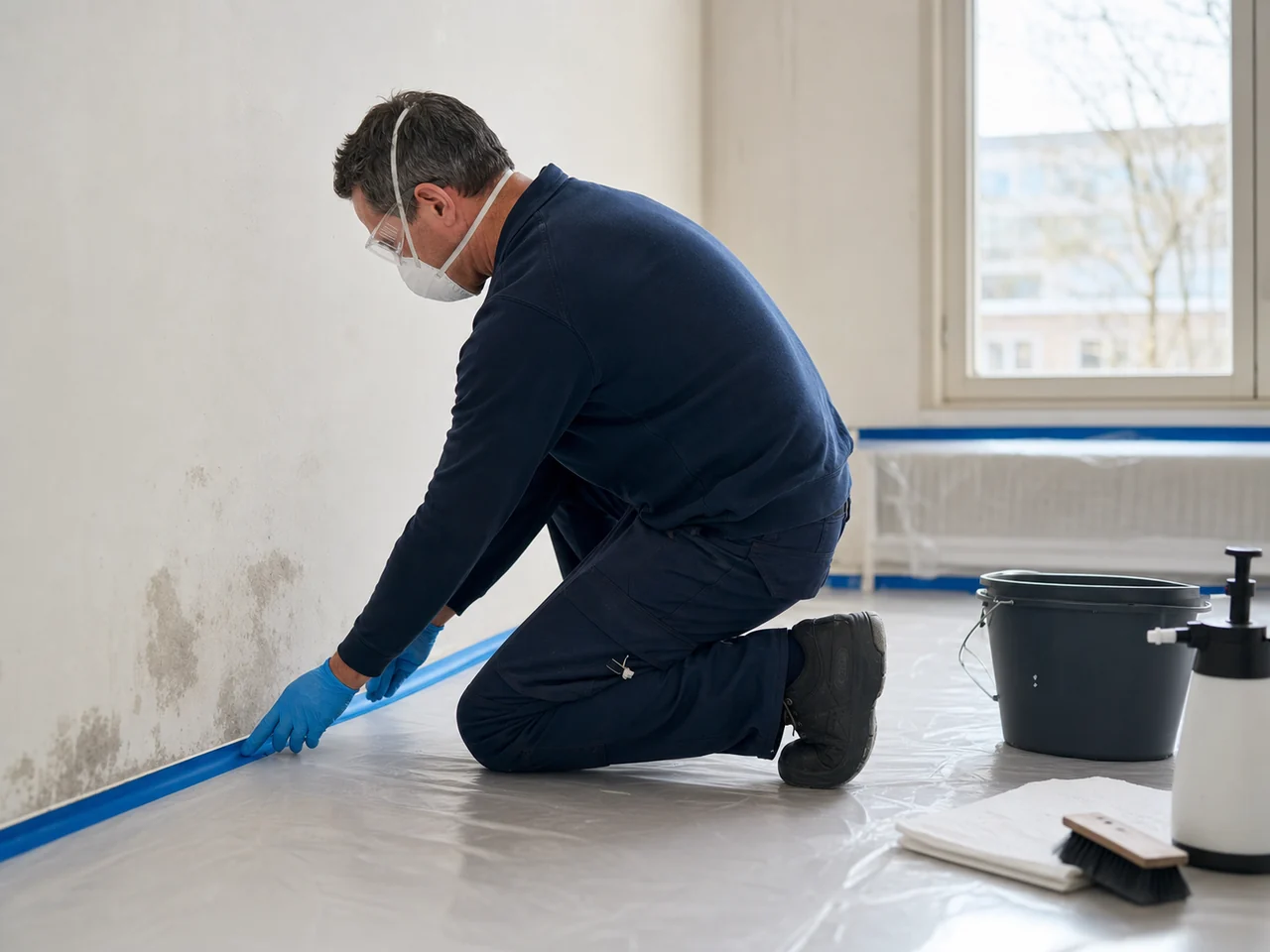
PPE for mould treatment requires attention to both mould spores and the products used. Therefore, always follow the current label and safety data sheet and adapt the working method, ventilation and personal protection to the product, dilution and application. This page provides general background; product-specific instructions and the workplace risk assessment take precedence.
Part 1 — Fungicides: The Cleaners and their safety
Fungicides fall within the broader group of biocides. The European Biocidal Products Regulation regulates the placing on the market and use of these products. In the Netherlands, a legally authorised biocide can be identified by the authorisation number on the label, as the Ctgb explains.
Inducoat Cleaner is an authorised biocide with authorisation number 12981N. The available safety data sheet classifies the concentrate with H314 and H410. Dilution can change the hazard classification, but the assessment and associated PPE must be based on current supplier documentation for the exact application.
Personal protective equipment
The personal protective equipment required depends on the product, concentration in use, application method and exposure. Follow the current label, safety data sheet and workplace risk assessment.
The RIVM emphasises that pesticides must be used in a targeted and safe manner. Therefore, do not determine a hazard classification or PPE choice yourself based only on a dilution percentage.

Important rules for use
Dilution can change the hazard classification of a mixture. This does not mean that a user can carry out a full CLP assessment or choose PPE independently. Use the current information for the exact product, prescribed dilution and chosen application method.
Inducoat Cleaner is an authorised biocide with authorisation number 12981N. The available safety data sheet classifies the concentrate with H314 and H410.
At the prescribed dilution of 1 part Cleaner to 10 parts water, the final mixture contains 0.455–0.909% of the corrosive quat according to the product-specific calculation based on the SDS, and therefore remains below 1%. Based on the generic CLP limits used for this calculation, this means for the stated working mixture:
– NO H314
– NO H315
– NO H318
– NO H319
According to this calculation, the mixture is no longer corrosive to the skin and eyes, but it may still cause irritation on contact. This is the calculation for the stated dilution and not a general product classification. The current label, safety data sheet and supplier instructions take precedence for the exact application and PPE choice.
The term biodegradable does not automatically mean that a product is environmentally neutral or harmless. Even a biodegradable cleaning product or biocide can pose a risk during use and impose requirements for dosing, storage and disposal.
The product data sheet describes Inducoat Cleaner as biodegradable. At the same time, the safety data sheet describes hazards for the concentrate. Use and disposal must therefore always follow the current label and safety data sheet; do not dilute or discharge the product based solely on the environmental claim.
Safe use of Inducoat Cleaner requires the prescribed application, correct dilution and product-specific protection. The practical properties of the product do not alter the obligation to follow the label, safety data sheet and workplace risk assessment.
Part 2 — Mould-resistant paints: what they do and where safety comes in
With a mould-resistant coating, the protection applies to the dry coating film. This property complements proper substrate preparation, ventilation, moisture control and maintenance.
For application and use, the current product data sheet and safety data sheet take precedence. The mould-resistant property in itself says nothing about emissions, health effects or the safety of a room.
Safety during application
During application, adequate ventilation, a controlled working method and following the product instructions are important. The gloves, eye protection or respiratory protection required depend on the product and application method.
Additional protection may be required in the event of spray mist or other exposure. Follow the label, safety data sheet and workplace risk assessment; there is no universal recommendation to use FFP2 protection for every coating.

Biocide in paint: useful, but not without obligations
When a coating contains a film preservative, product-specific information and labelling obligations apply. The composition, application and safety instructions must therefore be made clear to the user through the current product documentation.
With mould-resistant coatings, the biocidal protection applies to the dry coating film. This property is not proof that a room is safe, is not a health claim and is not a substitute for ventilation, cleaning or moisture control.
Prevention is key
PPE for mould treatment depend on the product and task. Assess mould spores, product, dilution, ventilation and application method together and follow the current label, safety data sheet and workplace risk assessment.